
No Kings 3: Building Visibility, Momentum, and Purpose in Greenville
A 9-million-strong national day of action drew 6,000 people into downtown Greenville. Organizers relay that visibility builds momentum, and photographer Atlas Solé captures a South pushing ahead with optimism and intention.
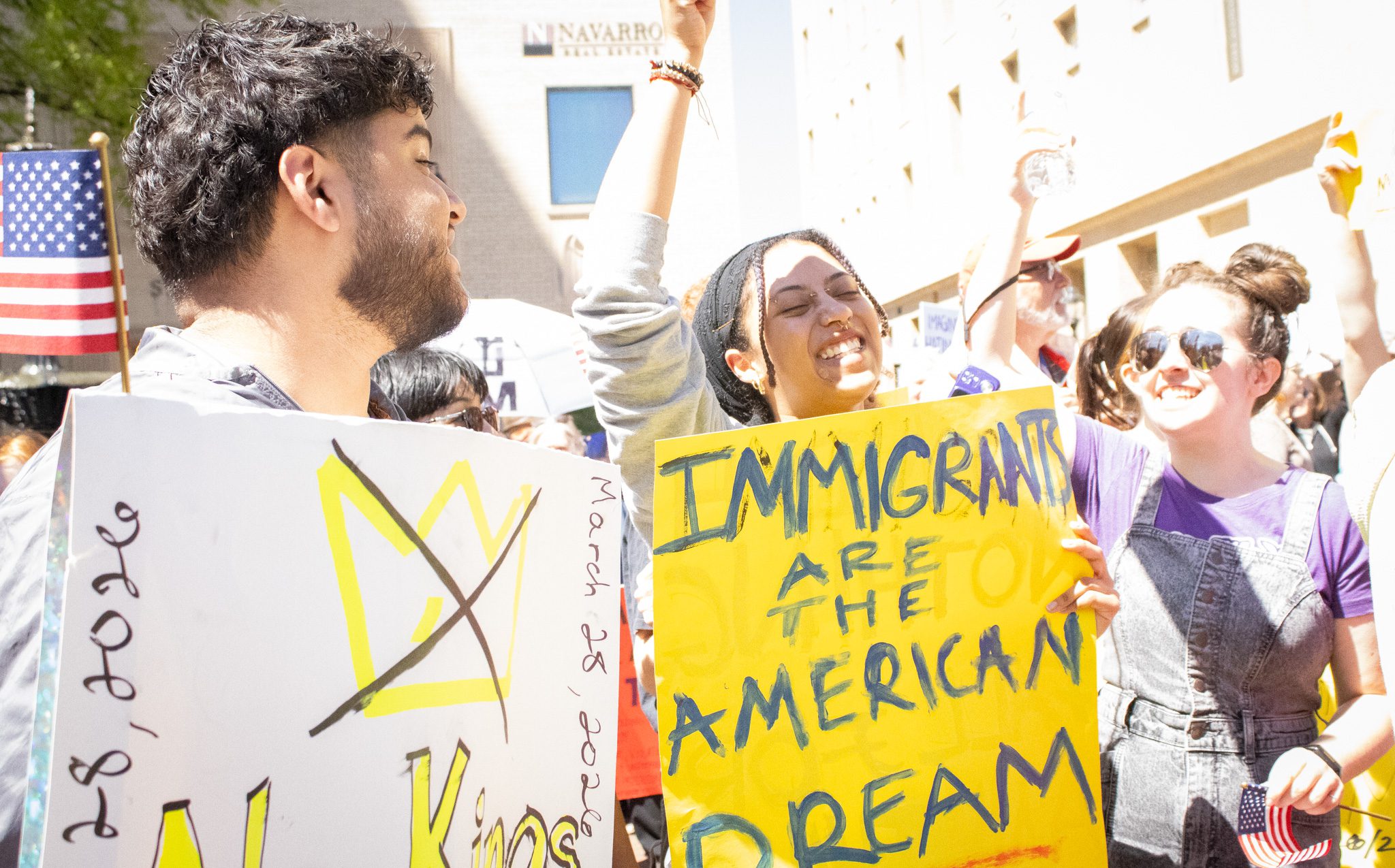
by Zamira Noam Solé
On March 28, 2026, citizens throughout our nation protested the MAGA regime, under the banner of NO KINGS 3 (NK3). In South Carolina alone, more than 32,000 people gathered in their cities to make one core message clear: we will have no kings in the USA!
In total, more than 3,000 events nationwide shared this message, ranging from small rallies to city-wide marches. Around the world, civilians held more than 30 solidarity events, spanning from Australia to Iceland. It was a nationwide action that managed to cross country borders once again.
Rallying throughout downtown Greenville
In downtown Greenville, 6,000 people participated in one or more consecutive gatherings. Starting at One City Plaza at 11:45 am and shifting to Greenville City Hall at 12:45 pm, the energized crowd was led in chants by organizers and volunteers. Demonstrators lined each side of the street, swarming onto the perron. At 3 pm, thousands converged at Falls Park for the main rally. It opened to the music of Steve Ramirez as attendees crowded up to the stage. On the walkways overlooking the bulk of the crowd, banners were held that read “Abolish 287G,” “ICE out,” and NO KINGS.
The first speaker was Michelle Shara, who organized the event alongside Brandii Roe. The activists co-lead protests in the Upstate for the organizations 50501 SC and Indivisible Upstate SC.
“Planning for NK3 and other events coming into 2026 is a different beast than in 2025,” said Brandii. “We have watched over the last 14 months as more and more people have had to stand up against executive overreach, deportations, and the slow erosion of things we took for granted.
“For me, NK3 in Greenville required this event to be disruptive. It is time to disrupt and push back—to take actions that get in the way, don't hide, and demand attention. Having people move through three stops on a busy downtown Saturday and basically take over Main Street was incredible. We brought thousands into the street, and I hope that's the momentum that everyone carries into 2026.”
Other rally speakers included Cody and Steven from the DSA, Bex Miller, Courtney McClain, Kwadjo Campbell, Mikayla Mangle, Efia Nwangaza, combat veteran and speaker Baron, and Community Heroes members Ana Thomas and Carolina Captain America (aka, Storm Bruner).
Baron is a veteran, circus performer, chef, farmer, and, above all, a believer in basic human rights. Greenville organizers met him while protesting in DC and invited him to share his passionate message at our NK3 event.
“I was never involved in protests until last year,” he said. “I could no longer take the level of disrespect given to people by those who should hold themselves to higher standards. We have to stand up for our communities and help those in need. Some would say I’m not the nicest person in the world, and they are right—I live in the middle of the woods for a reason. But I’m still trying to help my community.
“At this point, the government needs us more than we need them. The US government is like a deadbeat dad—they know you're there but won’t do a damn thing to help.”


All photos by Atlas Solé


The question of “performative” protests
The week after the event, Michelle shared her thoughts on the role of NK3 and some accusations of “performative” protesting. She has been the Upstate Representative for 50501 SC since February 2025 and has served as co-chair of protests for IUSC since June 2025—giving her an intimate view of both the criticism and the strategy behind protest organizing in 2026.
“Yes, our protests are permitted. Yes, we coordinate with the police. And yes, some people will call that performative,” she shared. “Honestly? They're not entirely wrong. But that misses the point of what protest is being used for now, especially in a red state like South Carolina.


“When people ask us if it's safe to come alone because they don't know a single person who will show up with them, that tells you everything. Social media algorithms don't show you the full picture of your own community. You can feel completely isolated in your values without ever knowing that thousands of your neighbors feel the exact same way.” Michelle explained that’s what NK3 and other national days of action are designed to address.
“We spread across all of downtown Greenville intentionally, because visibility was the whole point. And it worked. People saw us everywhere they turned.
“Here's the thing, though: visibility protests don't change policy on their own. And we don't live in 1965, where you needed a march to get a message out. Once those connections are made in person, we can mobilize that same crowd for email campaigns, office visits, boycotts, strikes, and candidate recruitment—all online. The protest is how you build the audience. Everything else follows from there.
“That's also why we keep our protests permitted, legal, and safe. We're not going to hand anyone a weapon to use against us while we're doing the hard work of building something real.”


“South Carolina isn't a red state, it's a gerrymandered state”
Those were the words spoken by Courtney McClain, the Democratic nominee for South Carolina's 4th Congressional district.
For protest photographer Atlas Solé, that sentiment is not just a campaign line—it reflects what he sees firsthand through his lens at protests in many states.
“I’ve been to my fair share of demonstrations along the east coast, but the ones here at home always mean the most,” he said. “I feel like the South and South Carolina have long been branded as the land of the oppressed and their rulers. And, while there is truth in this, we the people of SC are just as colorful and spirited in our desire for progress as our northern and western constituents.
“It’s through my work that I try to show this to the rest of the country. That we are not stuck in the past nor are we living in shame of it, but that SC is fighting for a better future if not a better present alongside the other states.
“I always go into these protests a little overwhelmed, worried that I won’t be able to capture the whole of its power. Crowd shots are important, but I mustn’t limit myself to such an outside perspective. I must capture moments from the inside as an active participant which also means shifting my focus from signs to the individuals that hold them. By the end, I was giddy for more.
“I remember thinking to myself as I walked through the crowd across Falls Park that it felt like the Fourth of July. There were no fireworks and no barbecue, but there was music; children were playing; people were meeting; tears were shed and laughter was shared; and there was intention.
“We had all gathered here because we care about this country and want her to be better. And I remember wanting nothing more than to hold my beloved’s hand.”


Zamira Noam Solé is a trans and Jewish activist born and raised in Nebraska; his foray into South Carolina activism started at the College of Charleston.
Atlas Solé is a freelance photojournalist and event photographer based in Upstate SC. Follow his work at atlassolephotograhy.myportfolio.com.
Share:
The IUSC blog exists to elevate SC voices, provide trustworthy information about key political issues, and help empathy-driven citizens mobilize and thrive. Visit our Website Content and Editorial Policies page for complete information.