
PAWs Report: Voter Eligibility Under Attack, 3/26/26
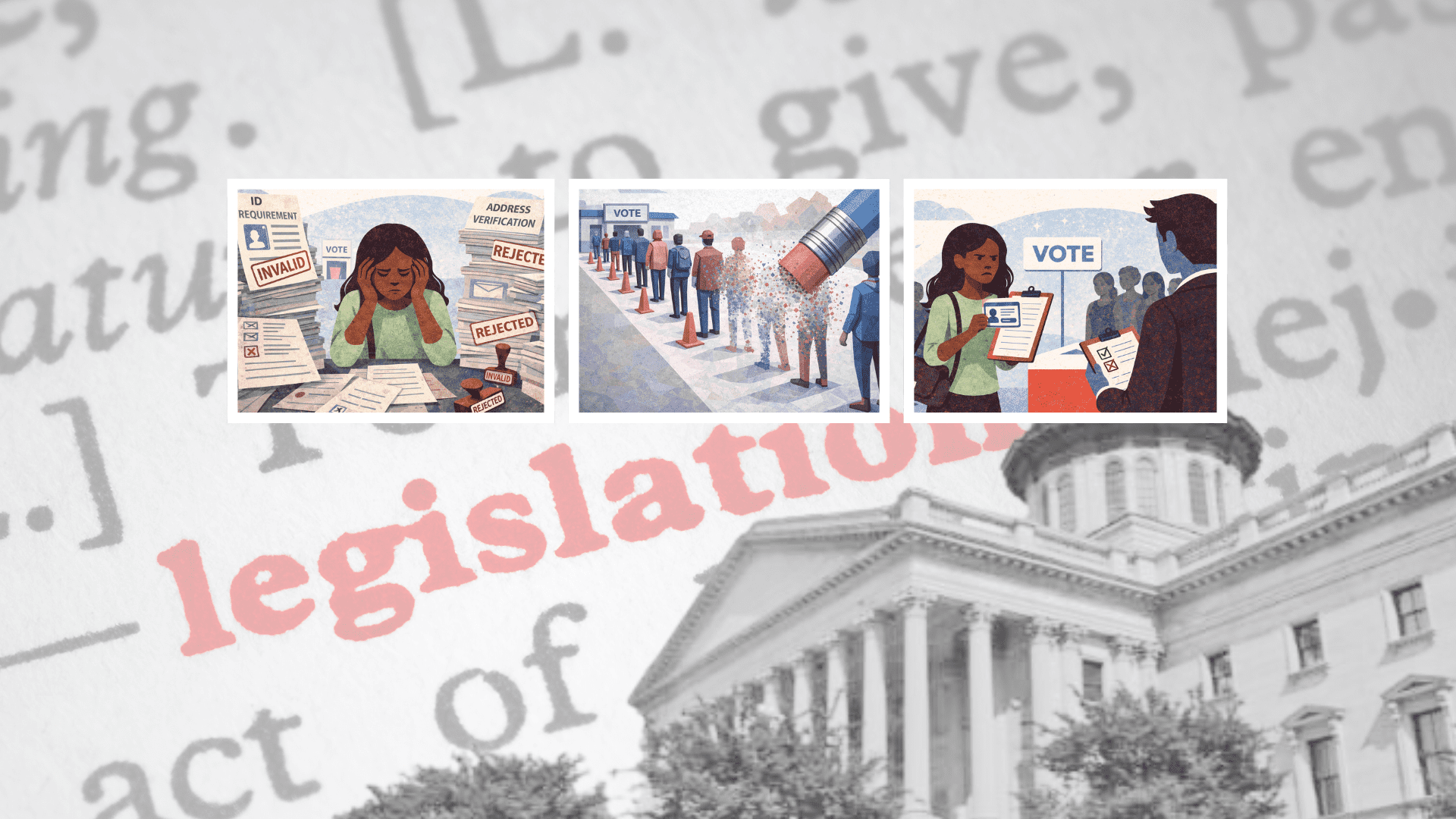
In an in-depth Political Action Watchdogs report, IUSC reviews the SAVE Act and similar bills in SC. Framed by many as 'commonsense' security, the proposals could disenfranchise millions of voters nationwide and hundreds of thousands in our state.
by Peggy Phillip
President Trump quietly voted by mail last week in a Florida special election. Then, in Memphis, he railed against “mail-in cheating” and when reporters asked about his hypocritical actions, the White House dismissed it as a “non-story.” In the same speech, Trump falsely claimed that the United States is the only country that allows mail-in voting. (At least 34 countries allow voters to mail in their ballots.)
And here’s the twist: his ballot was cast in Florida House District 87, where Democrat Emily Gregory unexpectedly flipped a Republican seat that includes Mar-a-Lago. The president’s home district is now represented by a Democrat in the Florida state legislature.
What is the national SAVE Act?
That surprise loss is almost certain to fuel the administration’s push for the “SAVE America” Act, a sweeping federal bill that would dramatically restrict how American citizens register and vote. Mail-in ballots like the one cast by the president last week would be banned. Moreover, the bill would require people to provide documentary proof of U.S. citizenship (like a passport, birth certificate, military ID) when registering to vote in federal elections. Millions of Americans lack easy access to citizenship documents (especially passports) due to inability to access records and/or the cost of obtaining proof that they are legal citizens.
Other things to know about the bill, from the National Conference of State Legislatures:
- The SAVE Act would require states to collect and document proof of citizenship from voters, which few states currently do, and establish additional voter list maintenance processes.
- Only a narrow set of voters (military, disabled, traveling) could vote absentee.
- States would get no federal funding to implement any of this.
- States that can’t comply might face running state and federal elections separately, with separate procedures, or they might have to keep separate lists of voters
- Every state would be required to submit its voter registration list to the Department of Homeland Security for comparison to their database, raising questions about the personal voter information and how it will be protected.
The Senate is in the midst of an extended public debate about the bill and is expected to pick up where they left off after a two-week break that starts March 30. Right now, SAVE is unlikely to pass given the deep-seated opposition from Democrats, who have the numbers to sustain a filibuster. Republicans lack the 60-vote supermajority needed to break the stalemate, but Trump is insisting they 'nuke' the procedural rule to force the law through anyway. Senate Majority Leader John Thune and several other Republican senators have resisted this option, citing the importance of protecting the minority party's rights for when Democrats regain control.
Some Republicans are considering trying to include the SAVE Act provisions in a budget reconciliation bill, which only requires 50 votes, though this is a challenging strategy. It’s kind of like trying a tricky shortcut that probably won’t work.
But this idea is upsetting the Republicans who strongly support the bill. They think using this complicated budget process—called “reconciliation”—is basically giving in to Democrats. They also don’t think it has much chance of succeeding because it only works if every part of the bill is directly related to the budget.
The SAVE America Act is a solution in search of a problem. Only citizens can vote in federal elections, and registrants must attest to citizenship (typically under penalty of perjury). The highly respected and non-partisan Brennan Center for Justice says “fraud is very rare, voter impersonation is virtually nonexistent, and many instances of alleged fraud are, in fact, mistakes by voters or administrators. The same is true for mail ballots.”
SC’s SAVE Act counterparts
Historically, South Carolina had significant barriers to voting (especially pre-1965 Voting Rights Act) but state laws have always made it more difficult to vote than other states. South Carolinians must register to vote 30 days before an election, the longest period allowed by federal law. Many states have shorter deadlines and some states allow same-day registration. Its felony disenfranchisement law disproportionately affects Black citizens.
In November 2024, South Carolina voters overwhelmingly passed a constitutional amendment making it clear that only U.S. citizens can vote in state elections. This didn’t really change the law—it was already the rule—but it sparked new efforts to add stricter checks to the voting process.
S.128 “Voter Registration”
South Carolina’s lawmakers eagerly jumped on the “show your papers” bandwagon in the current session. Senate Bill 128 (S.128) would require anyone registering to vote in South Carolina to provide documentary evidence of U.S. citizenship, as opposed to a signed statement under current law. The ACLU of South Carolina refers to S.128 as the “Proof of Citizenship for Voter Registration” bill.
S.128 is slightly more flexible than the national SAVE Act because a driver’s license or state ID issued after 1996 will qualify. However, the state bill is more aggressive about reviewing current voters than the SAVE America Act, which focuses mainly on new registrations. S.128 will require the Attorney General to review existing voter rolls. Currently, that is more than 3,370,000 registered voters. S.128 requires identifying those who haven’t provided proof and uses databases to verify citizenship. This is a significant expansion beyond registration.
South Carolina has been progressive in one way: it has allowed fully-online voter registration for years for anyone with a SC drivers license. This bill adds extra steps and friction to that process. People who apply online would still have to submit documents before they’re actually registered. That creates more work for election offices and could slow down or delay registrations, increasing the chances that eligible voters won’t complete the process in time, and may be turned away at the polls.
S.128 is the furthest along of the proposals in South Carolina, but as of March 2026, it’s still stuck in committee. The fact that it’s been carried over—and that Sen. Thompson is still working on changes—means it’s not dead, just not moving fast. Given the current political climate, there’s a good chance some version of this bill will pass.
Additional SC bills
Other bills tightening state controls over voting rights have been introduced this legislative session.
- H.3459 says organizations intending to conduct registration drives must now register with the State Election Commission and follow specific state requirements.
- H.5278 was introduced in February. It aims to restrict voter registration and voter registration cards to U.S. citizens only. It amends existing code to prohibit non-citizens from being issued voter registration cards.
- H.3628 is known as the "Secure, Accurate, and Verifiable Elections Act" and focuses on election security and procedures.
- S.872 proposes requiring proof of U.S. citizenship for driver's licenses. Non-citizens legally in the U.S. would receive a license marked with an "NC" designation, and these marked licenses would not be accepted for voting purposes.
- H.4295 is a sweeping overhaul of SC elections. It includes everything in S.128 and adds more layers and ongoing enforcement.
All of these bills remain in committee. Advocacy groups are advised to track H.5278 and H.4295 for committee activity—these could move independently or be merged into S.128.
Repercussions
The potential impact of both the federal SAVE Act and proposals under consideration in the South Carolina legislature is particularly concerning for groups more likely to face documentation barriers, including women, older voters, low-income individuals, and people born at home or without formal records.
Using the most widely cited, nonpartisan estimates, there are more than 4 million people in South Carolina of voting age. Of those, about 370,000 do NOT have ready access to proof of citizenship documents like a passport or birth certificate. These citizens will have to track down documents, pay for replacements and take extra steps to register.


A smaller but more serious subgroup is that between 40,000-80,000 people in South Carolina don’t have these documents at all and would need significant effort to complete their registration. A new U.S. adult passport costs $130 (application fee) plus a $35 acceptance fee.
For married women in South Carolina, this legislation will create significant voting barriers, because it disproportionately affects those who changed their last names after marriage. The League of Women Voters of South Carolina stated this legislation would eliminate common registration methods like mail-in or online voter registration, forcing voters to show original proof of citizenship in person. It’s particularly burdensome for women in rural South Carolina, like Abbeville County, or those with limited transportation, who might live far from election offices. Urban counties like Greenville and Spartanburg have higher populations of younger voters, renters and name-change cases so tens of thousands are potentially affected.
It’s not all bad news. The South Carolina Legislature is scheduled to adjourn the regular 2026 session on May 7. And all bills that have not been passed cease to exist. That won’t eliminate voter suppression threats completely, though—voter rolls are still being purged, ICE agents may staff polling locations, and mail-in voting is being targeted at both the Supreme Court and USPS.
The bottom line
The SAVE America Act and the companion bills in South Carolina would force every voter—even those registered for decades—to appear in person with citizenship documents. Online voter registration would be gutted. Mail-based registration would end altogether. Registration drives would become nearly impossible.
Supporters say the goal is to ensure that only citizens vote. But federal law already requires citizenship, and violations are rare and heavily punished. The SAVE Act would layer documentation requirements onto an existing system already in place.
Every elected official, every secretary of state, every mayor should be put on record now: How will you protect the vote? How will you stand up to federal and state overreach at the ballot box?
This is happening now. And the window to act is short.
How to take action
Action is the antidote to anxiety. You can reach out directly to your representatives using the information below, and you can also raise awareness in your own circles. Take a moment to think—what groups are you a part of? Dance teams, recreational softball, church groups, the few people you chat with while waiting to pick up kids or grandkids from school. We’re not asking you to pick up a bull horn and stand on a street corner, but factual information from trusted messengers goes a lot farther than you think.
THE NATIONAL SAVE ACT
Call our US Senators today and tell them to vote NO on the SAVE America Act
- Sen. Lindsey Graham: 202-224-5972
- Sen. Tim Scott: 202-224-6121
- Capitol Switchboard: 202-224-3121
State your name and city of residence and say this:
“I’m a South Carolina voter. Please vote NO on the SAVE America Act. We already have laws preventing non-citizen voting, which is extremely rare. Passport ownership rates in South Carolina are below the national average and concentrated in rural and lower-income communities—the populations most affected by restrictive documentation requirements. This bill makes it harder for eligible Americans to vote and does not solve a real problem.”
SC BILLS
Reach out to state legislators from the Upstate who sit on Judiciary Committees in the Senate and the House.
| SC Senate Judiciary Committee | SC House Judiciary Committee |
| District 11-SpartanburgJosh Kimbrell803-212-6108 | District 31--SpartanburgRosalyn Henderson-Myers864-345-2221 |
| District 6-GreenvilleJason Elliott864-235-5308 | District 13-GreenwoodJohn McCravy864-942-8501 |
| District 12-Spartanburg/GreenvilleLee Bright864-978-9522 | District 33- SpartanburgTravis Moore803-212-6893 |
| District 3-AndersonRichard Cash803-212-6124 | District 22-GreenvillePaul Wickensimer803-212-6877 |
State your name and city of residence. Here’s a script:
“I’m a South Carolina voter urging you to say no to restrictive voting laws being considered in Columbia right now. These include S.128, H.3459, H.5278, H.3628, S.872, and H.4295. On SC Judiciary committees, there are 25 members on the House side. Six are women. On the Senate side, of the 23 members, only one is a woman. In every single county in South Carolina, women outnumber men at the polls. They show up and they vote. And if these laws pass, being a woman means you can be told to jump through different hoops than men, even if you are a citizen and a voter. These laws will affect women who are not illegal immigrants. Protect these women. Protect these low-income, rural constituents. Don’t make it harder with unnecessary barriers.”
Peggy Phillip, a 44-year veteran of broadcast journalism and lifelong voter since 1978, is now a retired and devoted grandma, championing a better future for all.
Article Sources
- https://www.ncsl.org/state-legislatures-news/details/9-things-to-know-about-the-proposed-save-america-act
- https://www.brennancenter.org/topics/voting-elections/vote-suppression/myth-voter-fraud
- https://www.epi.org/publication/rooted-racism-voter-suppression/
- https://scvotes.gov/wp-content/uploads/2024/01/scec_11854_19_Security-Booklet_Jan2024_WEB_01.pdf
- https://palmettostatewatchfoundation.com/2026/03/19/legislative-cover-how-south-carolinas-legislature-helped-create-the-election-commission-mess-it-now-claims-to-fix/
- https://scdailygazette.com/briefs/longtime-greenville-voting-director-tapped-to-lead-sc-election-commission/
- https://www.southcarolinapublicradio.org/2025-04-13/will-the-save-act-make-it-harder-for-married-women-to-vote-we-ask-legal-experts
Share:
The IUSC blog exists to elevate SC voices, provide trustworthy information about key political issues, and help empathy-driven citizens mobilize and thrive. Visit our Website Content and Editorial Policies page for complete information.